

5 min read
 Manuel Herranz: 11/11/25
In 2025, Salt Lake City was more than just a conference venue. Surrounded by impressive mountains, the TAUS conference became the stage for a turning...
11 min read
25/06/2026
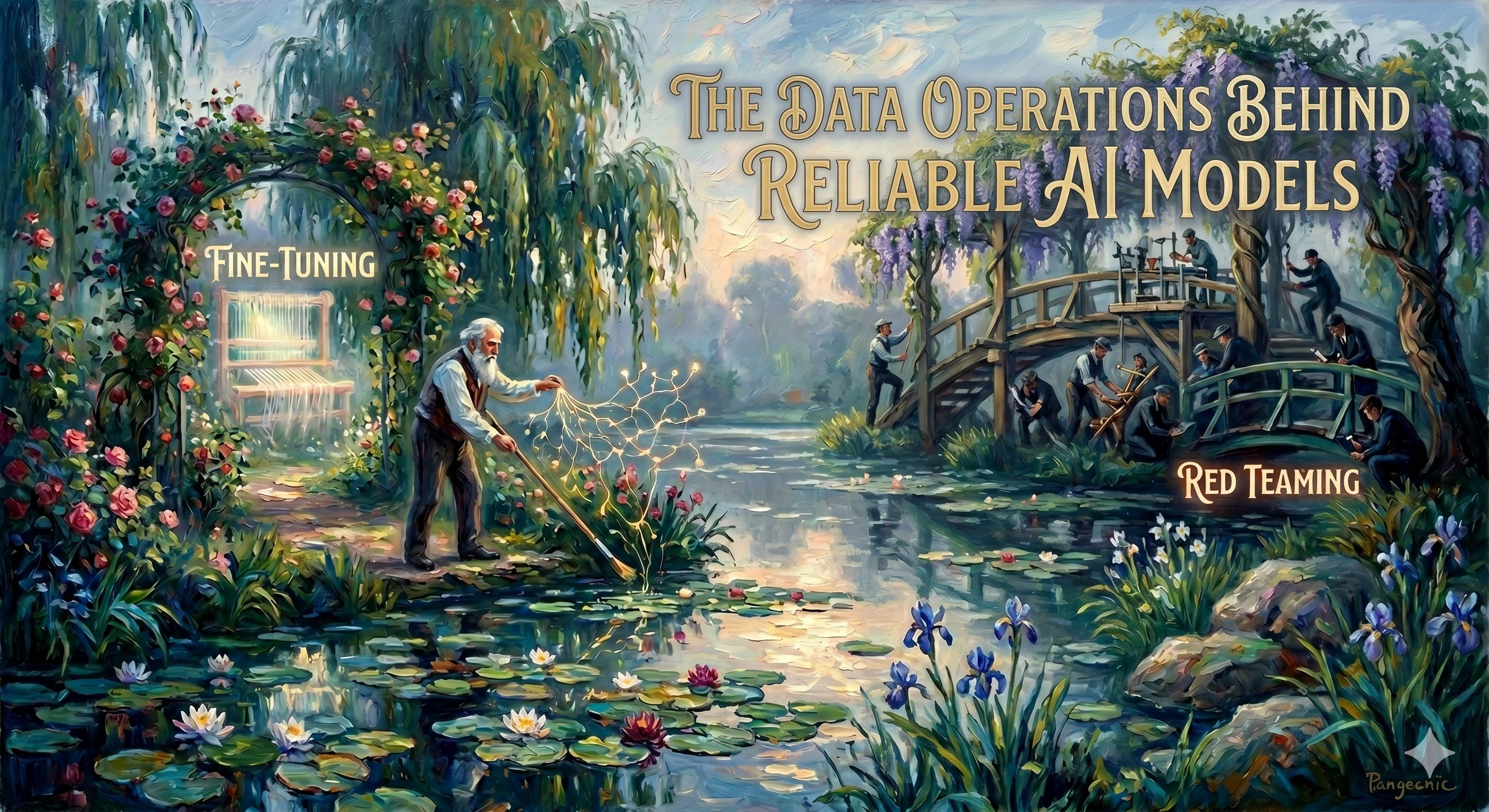
Reliable AI is built after the model has been selected. The decisive work begins when an organization defines the behavior it expects, creates data that demonstrates that behavior, tests the model under realistic pressure and converts each confirmed failure into evidence for the next improvement cycle.
By José Miguel Herrera Maldonado, PhD, Head of Machine Learning at Pangeanic
Technical and editorial review by Manuel Herranz, Founder and CEO of Pangeanic
An AI alignment data operation is the managed production system that connects instruction data, expert demonstrations, human feedback, adversarial testing, failure analysis, remediation data, and regression testing. Its purpose is to make model behavior measurable, correctable, and repeatable within a specific business, language, and risk context.
For enterprise teams, the key question is no longer whether a model can generate a plausible answer, but whether it can follow the correct process, apply the relevant policy, preserve meaning across languages, and behave consistently when instructions become ambiguous or adversarial.
The first wave of generative AI encouraged organizations to think primarily about model access. Teams compared parameter counts, context windows, benchmark scores, and subscription plans. The fastest route to experimentation was usually an API connected to a general-purpose model.
Production changes the question. Once a model enters a legal workflow, customer service process, technical support environment, industrial operation, or public administration, broad intelligence becomes less important than predictable behavior within a defined perimeter.
An enterprise does not need a model to answer every possible question. It needs the system to perform specific tasks under known conditions, recognize when those conditions have changed, and respond appropriately when it lacks evidence, authority, or confidence.
This helps explain the growing interest in smaller, task-specific models. Gartner predicted in 2025 that by 2027, organizations would use small, task-specific AI models at least three times as often as general-purpose large language models, and everything seems to point in that direction. The economics behind this shift are important, of course (at the end of the day, Palantir seems to be making a lot of token dollars from captive clients as "the new coal"), but the reality is that control matters just as much. A specialized model can be trained, tested, and governed around a narrower behavioral contract.
That narrower perimeter creates a more demanding data problem. A task-specific model requires examples that represent the task, its terminology, languages, exceptions, policies, and the expected outputs. Generic internet text provides breadth. It rarely provides the precise behavioral evidence an enterprise needs.
Supervised fine-tuning begins with examples. A model receives an instruction and a reference response that demonstrates what good performance looks like. At sufficient quality and coverage, these examples shape how the model interprets requests, organizes answers, and follows domain conventions.
In an enterprise setting, instructional data can encode much more than factual knowledge. It can demonstrate how to classify a document, extract fields, summarize a case file, apply approved terminology, produce a structured report, use an internal tool, escalate an exception, or refuse a request that crosses an agreed boundary.
The difficult part is not producing a large number of prompt-response pairs. The difficult part is deciding which pairs deserve to become part of the model’s education.
A plausible answer may still be procedurally wrong. A polished response may omit a mandatory warning. A correct English example may cease to be correct when adapted to another jurisdiction. A synthetic answer may reproduce the assumptions of the model that generated it.
Good instruction data, therefore, needs a task taxonomy, annotation guidelines, acceptance criteria, expert validation, and sufficient variation to represent the real operating environment. Examples should include ordinary cases, ambiguous cases, exceptions, and controlled failures.
Many enterprise tasks cannot be evaluated solely by checking the final response. The route to the answer is often as important as the answer itself.
A model can reach a correct conclusion through invalid reasoning. It can also follow a largely correct process and make one local error that corrupts the result. Those cases require different interventions. The first suggests that the model has learned a dangerous shortcut. The second may indicate a calculation, retrieval, or formatting problem.
As detailed in Pangeanic’s methodology for expert reasoning data and verified solution traces, domain specialists can create or validate difficult tasks, document the relevant assumptions, structure intermediate steps, and establish a defensible reference answer.
This material supports supervised fine-tuning, gold-standard evaluation, model comparison, and diagnosis of the exact step where reasoning began to drift.
The distinction is especially important in mathematics, engineering, finance, science, software, and regulated decision support. A final answer without a validated path resembles a bridge inspected only at its destination. It may still be standing, but nobody has examined the load-bearing structure.
Reasoning datasets also support more useful failure taxonomies. Reviewers can record where an error appeared, what principle was misapplied, why the mistake propagated, and how much it altered the outcome. This yields far more usable evidence than a binary label indicating the answer was wrong.
Training examples show a model how it should behave. Red teaming examines whether that behavior remains stable when the input becomes difficult, adversarial, or unfamiliar.
Language model red teaming is often associated with jailbreaks and harmful content, and those areas remain important, for sure, but enterprise red teaming covers a much wider field. A model can fail by complying too readily, refusing legitimate work, fabricating evidence, applying the wrong policy, losing track of the instruction hierarchy, or producing different decisions in different languages.
As we detail in Pangeanic’s methodology for Multilingual AI Red Teaming and Behavioral Safety Evaluation, testing should cover reasoning, policy compliance, refusal behavior, grounding, bias, cultural interpretation, and cross-language consistency.
Multilingual red teaming is particularly important because policies and evaluation sets are frequently designed around English. A safeguard that appears robust in English may weaken when a user switches languages, uses a dialect, employs culturally specific euphemisms, or distributes an adversarial request across several conversational turns, and translation alone does not solve this problem. A translated prompt preserves the assumptions of the original test designer. A genuinely multilingual evaluation must consider how users formulate requests in the target language, which cultural references they use, and how politeness, authority, ambiguity, and indirectness are expressed.
A useful red teaming result should identify four elements:
1. Where: the turn, reasoning step, language transition, or instruction boundary where behavior departed from expectations.
2. What: the policy, reasoning rule, factual requirement, or linguistic constraint that failed.
3. Why: the likely mechanism behind the failure.
4. Impact: the effect on the answer, user, organization, or deployment risk.
This structure separates an unusual response from a confirmed failure. It also gives engineering, governance and data teams something they can act upon.
Traditional evaluation remains useful, but it often stops when a benchmark score has been calculated. Alignment data operations extend beyond the score, turning the findings into assets for model improvement.
|
Traditional model evaluation |
Alignment data operations |
|---|---|
|
Produces a benchmark score |
Produces diagnostic and reusable data |
|
Often measures final answers |
Examines outputs, reasoning, policies, and behavior |
|
Usually performed at a fixed point |
Continues across model, prompt and policy versions |
|
Reports failures |
Converts failures into remediation data |
|
Often centered on English |
Tests language, regional, and cultural variation |
|
Uses generic public test sets |
Builds private, deployment-specific regression suites |
|
Answers whether a model passed |
Explains where it failed and what should change |
The NIST AI Risk Management Framework supports this lifecycle view by treating risk management as a continuous activity involving governance, mapping, measurement and management. Its Generative AI Profile extends that logic to risks associated with generative systems.
Many evaluations end with a scorecard. The model receives a percentage, the team reviews several examples, and the document is placed beside earlier benchmark reports. The organization has measured the problem without creating a mechanism to correct it.
Every confirmed failure can become a new data asset.
An unsafe response can be paired with a compliant alternative. An excessive refusal can become an example of permitted behavior. A reasoning defect can be reconstructed as a verified solution trace. A cross-language inconsistency can become a parity test. A fabricated citation can become a grounding requirement and a regression case.
This creates a practical alignment loop:
The loop is cumulative. Each cycle expands the organization’s knowledge of its model, users, policies, and edge cases. Over time, the private evaluation and remediation corpus may become more valuable than the original model weights because it captures operational experience that cannot be downloaded from a public repository.
Models change. Providers update them, prompts evolve, retrieval systems are modified, and internal policies acquire new exceptions. A model that passed an evaluation six months ago may behave differently after any of these changes.
Regression suites provide a stable point of comparison. They contain validated tasks, expected behaviors, known failures, and acceptance thresholds, all of which can be rerun whenever a component changes.
This is how evaluation becomes institutional memory. The organization no longer relies on a few employees remembering that an earlier model mishandled a particular request. The failure is preserved as a test, together with its context and expected outcome.
Private benchmarks are especially valuable in regulated or proprietary domains because public benchmarks may not capture internal terminology, processes, risk tolerances, or confidential knowledge. A bank, ministry, pharmaceutical company, and industrial manufacturer may use similar base models while requiring very different evidence of acceptable behavior.
Organizations still tend to build in English and localize later. This sequence is familiar from software development, but in AI the consequences are more serious because language affects behavior rather than presentation alone.
A model may understand a sentence in several languages while applying different levels of caution, specificity or factual rigor to each. It may recognize a policy term in English and miss its nearest legal equivalent in Spanish. It may refuse a direct request but comply when the same request is expressed through an idiom or culturally specific analogy.
Multilingual alignment requires language-aware data throughout the lifecycle:
Pangeanic’s history in language technology began with the collection and alignment of multilingual data for machine translation systems. That experience established a principle that remains relevant for generative AI: linguistic equivalence is rarely achieved through substitution alone. Meaning depends on domain, context, audience, and purpose.
The same principle now applies to model alignment. The unit of quality is no longer simply the translated sentence. It is the model behavior that the sentence elicits.
Human feedback is often discussed as though it were a raw material that can be purchased by volume. In practice, its usefulness depends on who provides it, what reviewers are asked to judge, and how disagreement is resolved.
A general reviewer can identify obvious harmfulness or poor writing. A lawyer may be required to judge whether a response preserves legal meaning. An engineer may need to determine whether a solution is consistent with a valid physical assumption. A native speaker may identify a cultural failure that remains invisible to a technically fluent non-native reviewer.
Contributor selection is therefore part of model design.
Projects also need clear rubrics. Reviewers should know whether they are evaluating factuality, relevance, reasoning, policy compliance, tone, cultural adequacy, or several dimensions separately. Mixing these into a single preference score yields data that are easy to collect but difficult to interpret.
Disagreement should be recorded rather than quietly averaged away. Some cases reveal a weak guideline rather than a weak model. Adjudication may show that the expected behavior was ambiguous, internally inconsistent, or difficult to apply across jurisdictions.
The resulting process resembles a well-run laboratory more than a crowd task. It requires instructions, calibration, controlled variation, review, traceability, and an account of uncertainty.
When we talk about “data operations” at Pangeanic, we do so meaningfully, as it shifts attention from a static dataset to a managed production system.
Reliable model alignment requires continuous coordination among data specialists, domain experts, linguists, annotators, model engineers, evaluators, security teams, and policy owners. Each group sees a different part of the system. The data operation connects those views through common formats, taxonomies, quality gates, and feedback loops.
A mature alignment data operation should be able to answer several practical questions:
Without this connective tissue, organizations accumulate isolated assets: a fine-tuning set from one provider, a red team report from another, evaluation spreadsheets maintained by a third, and internal feedback stored in application logs. The individual components may be competent while the overall system remains amnesiac.
General models are increasingly accessible. Instruction data, evaluation protocols and accumulated knowledge of failure modes are much harder to reproduce.
An enterprise that records validated examples, reviewer decisions, edge cases and regression tests develops a proprietary behavioral map of its AI system. Competitors may license the same base model, but they will not possess the same map.
The advantage comes from knowing where the system breaks, why it breaks and which evidence is required to repair it.
This data also reduces dependency on a single model provider. When an organization owns its task definitions, instruction corpus, reference answers and evaluation suites, it can compare models or migrate between them with greater confidence. The model becomes a replaceable component inside a more durable knowledge and control architecture.
For sensitive environments, this material may need to remain inside private cloud, on-premises or air-gapped infrastructure. System prompts, internal policies, user transcripts and confirmed vulnerabilities can be as sensitive as the documents the model processes. Sovereignty applies to alignment data as much as it applies to model hosting.
The enterprise AI discussion is moving beyond the spectacle of larger models. The difficult work now concerns stewardship: deciding what a model should do, observing what it actually does and maintaining the evidence required to close the distance between the two.
Fine-tuning, expert reasoning data, red teaming and evaluation belong to one operational continuum. Fine-tuning teaches. Reasoning data clarifies. Evaluation measures. Red teaming contradicts. Remediation corrects. Regression testing remembers.
The model sits at the center of this cycle, but it does not control the cycle. The organization does.
The best governed systems will not be those that never fail. They will be those whose failures are found deliberately, explained precisely and converted into better data before users discover them by accident.
A confirmed failure is first documented against an expected policy, answer, or behavioral standard. Reviewers then create a corrected response, preferred response, contrastive example or expert demonstration. The original failure and corrected behavior can be used for fine-tuning, preference optimization or regression testing.
Language changes how users express authority, ambiguity, indirect requests, cultural references, and sensitive concepts. Translating an English test does not reproduce these behaviors. Multilingual alignment, therefore, requires language-specific instruction data, native adversarial scenarios, and human evaluation throughout the model lifecycle.
An expert reasoning trace is a validated sequence of assumptions, intermediate steps, calculations, or decisions that connects a task to its reference answer. It allows model teams to evaluate how a conclusion was reached rather than checking only whether the final answer appears correct.
A benchmark measures model performance against a defined set of tasks. A regression suite preserves validated cases, known failures and expected behaviors so the organization can check whether later changes to the model, prompt, retrieval system or policy have reintroduced earlier defects.
Pangeanic supports multilingual AI data operations for training, supervised fine-tuning, expert reasoning, human feedback, adversarial evaluation and continued model improvement.
Discuss your model alignment and AI data requirements with Pangeanic.
5 min read
Manuel Herranz: 11/11/25
17 min read
 Amando Estela: 12/17/25
11 min read
Manuel Herranz: 07/31/26