

18 min read
 Manuel Herranz: 03/28/26
From Values Engineering to the Sovereign AI Era
-4.png)
5 min read
29/12/2023
Updated March 2026 for enterprise LLMs, SLMs, and AI Data Operations.
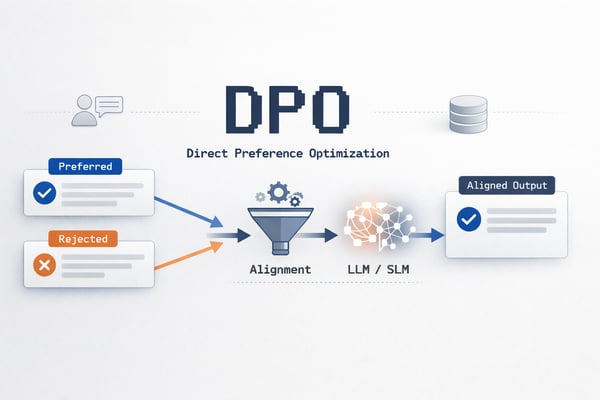
Direct Preference Optimization (DPO) is a preference-alignment method that fine-tunes language models using pairs of preferred and rejected responses. Instead of training a separate reward model and then optimizing with reinforcement learning, DPO learns directly from preference data, making alignment simpler and often more efficient.
For enterprise AI teams, DPO is especially relevant when models need to reflect domain terminology, brand voice, compliance rules, and multilingual user expectations. It gives organizations a more direct way to align model behaviour with real business needs, especially when generic base models are not accurate enough for regulated, high-value, or customer-facing tasks. In that sense, DPO is best understood as part of a broader AI Data Operations workflow rather than as an isolated model-training technique.
In practice, DPO sits within the broader post-training and model-alignment workflow. After supervised fine-tuning, organizations can use human preference data to teach a model whose answers are more helpful, safer, more accurate, or better aligned with internal policies. This is particularly useful when building task-specific Small Language Models for sectors such as healthcare, finance, legal services, customer support, and multilingual enterprise operations.
Supervised Fine-Tuning teaches a model using example prompts and ideal outputs. It is often the first post-training step and works well for formatting, task structure, and domain adaptation.
Reinforcement Learning from Human Feedback uses preference data to train a reward model, which is then optimized through reinforcement learning. It is powerful, but can be more complex to implement and maintain.
Direct Preference Optimization learns directly from preferred versus rejected outputs, without a separate reward model. This makes alignment workflows simpler and often more practical for enterprise model customization.
DPO stands out because it helps align models more precisely in complex, high-stakes environments. In healthcare, for example, it can support model adaptation for clinical summarization, patient communications, or knowledge workflows where accuracy, tone, and terminology matter. Input from domain experts becomes essential, helping the model better reflect real-world professional expectations.
In financial services, DPO also has clear relevance. Preference data from analysts, reviewers, and subject matter experts can help align outputs for investment research, compliance-sensitive reporting, risk communications, and multilingual documentation. The result is not just a more fluent model, but one that is more consistent with enterprise rules and expert judgment.
Like all human-in-the-loop alignment methods, DPO depends on high-quality preference data. Collecting that data at scale requires well-designed workflows, clear reviewer instructions, robust adjudication, and strong quality assurance. Without those foundations, preference signals may become noisy, inconsistent, or overly subjective, making them unreliable for producing reliable gains.
Another challenge is operational. Enterprises need to define what “better” means for each use case: more accurate, safer, shorter, more on-brand, more compliant, or more useful for a specific audience. That means DPO works best when it is supported by structured annotation programs, carefully designed taxonomies, multilingual reviewer teams, and governance processes that ensure repeatability over time.
Despite these challenges, DPO is increasingly relevant because it reduces complexity in preference alignment while still capturing human judgment. For organizations building custom AI, it offers a pragmatic route to stronger model behaviour without relying only on generic benchmarks or raw scale.
To work effectively, DPO requires more than random user feedback. It needs structured, high-quality preference datasets that reflect the real behaviour an enterprise wants from its models. In practice, that usually means combining prompts, candidate outputs, reviewer decisions, and quality controls in a format suitable for model alignment. This is why preference tuning should be anchored in strong datasets for AI training and disciplined data operations.
The core training signal in DPO is a pair of outputs for the same prompt: one preferred and one rejected. These pairs can be created from model generations, human rewrites, or comparative review workflows. The clearer the contrast between good and bad outputs, the stronger the alignment signal.
Preference data is only useful when reviewers apply consistent standards. Teams need explicit instructions covering accuracy, tone, terminology, policy compliance, harmful content, hallucination risk, formatting expectations, and task-specific success criteria. Strong guidelines reduce disagreement and improve dataset reliability.
For global enterprise AI, preference alignment must work across languages, not just English. Multilingual labeling helps ensure that brand voice, domain terminology, safety rules, and user expectations are preserved across markets. This is especially important for customer service, regulated documentation, and multilingual content operations, where text data annotation services provide the review layer needed to produce reliable human preference signals.
DPO datasets need continuous QA. That includes reviewer calibration, spot checks, consensus review, dispute resolution, and, where relevant, measurement of inter-annotator agreement. Without QA, preference data can drift over time, reducing the effectiveness of alignment.
In a practical enterprise workflow, DPO usually follows supervised fine-tuning. A base or domain-adapted model first learns the general task structure, terminology, and expected answer format. Once that baseline is established, the next step is to collect comparative human judgments on model outputs for relevant prompts and use cases.
Those judgments are then transformed into preference pairs, where one answer is marked as better than another according to enterprise criteria. Instead of training a separate reward model and running a more complex reinforcement learning pipeline, DPO uses those preferences directly to update the model, making future outputs more likely to align with reviewer expectations.
One of the main advantages of DPO is that it makes preference alignment more operationally accessible. It helps bridge the gap between raw model capabilities and enterprise-grade usability by incorporating human judgment in a more direct, structured way. For organizations working with multilingual content, domain-specific terminology, or regulated outputs, this can make a meaningful difference in reliability.
It is also useful to understand how DPO differs from RLHF. Both approaches use human preferences, but RLHF typically introduces a reward model and a reinforcement-learning stage, whereas DPO learns from comparative preferences more directly. For many enterprise teams, this makes DPO easier to test in a controlled production pipeline.
In conclusion, DPO is not just a research concept. It is becoming part of the practical toolkit for building better-aligned language models and task-specific Small Language Models. When supported by strong AI Data Operations, high-quality training datasets, and multilingual annotation workflows, it gives enterprises a clearer path from human judgment to model improvement.
Pangeanic helps organizations prepare, label, evaluate, and align multilingual datasets for enterprise AI, from annotation and reviewer workflows to task-specific model customization.
AI Data Operations Discover how Pangeanic structures multilingual data pipelines for model training, alignment, and evaluation. Text Data Annotation Services Explore human-in-the-loop annotation, labeling, ranking, and review workflows for AI training data. Task-Specific Small Language Models See how domain-adapted SLMs can deliver more accurate, efficient, and governable enterprise AI.
Talk to Pangeanic about preference data, model alignment, annotation services, and enterprise AI customization.
Direct Preference Optimization (DPO) is a preference-alignment method used to fine-tune language models on pairs of preferred and rejected responses. It helps align model behavior with human judgment without requiring a separate reward model.
RLHF typically trains a reward model and then optimizes a language model through reinforcement learning. DPO learns directly from preferred-versus-rejected outputs, which often makes the alignment workflow simpler and easier to operationalize.
DPO requires structured preference data: prompts, candidate outputs, reviewer choices, annotation guidelines, multilingual labeling where relevant, and quality assurance processes such as adjudication and calibration.
For enterprise AI deployed across markets, multilingual labeling helps preserve terminology, tone, compliance rules, and user expectations across languages. This is especially important in customer support, regulated documentation, and domain-specific AI workflows.
DPO is useful when a model must reflect human preferences such as accuracy, safety, brand voice, compliance, or domain-specific expectations. It is particularly relevant after supervised fine-tuning and before production deployment.
Yes. Pangeanic supports AI Data Operations, multilingual datasets, text annotation, human review, evaluation workflows, and task-specific Small Language Model customization for organizations building better-aligned enterprise AI systems.
15 min read
Manuel Herranz: 06/25/26
14 min read
 Ainara García: 07/01/26