

19 min read
 Marina Albert Girona: 06/09/26
A translation can be accurate and still fail the job. That is the uncomfortable reality behind the next phase of Machine Translation Quality...
8 min read
29/07/2026
LREC 2026 | MULTILINGUAL AI, LANGUAGE RESOURCES AND EVALUATION
Evaluation, multilingual data and controlled deployment are moving to the center of enterprise AI.By Manuel Herranz
July 2026
One striking observation at LREC 2026 was how rarely the most consequential discussions revolved around building ever-larger language models. Across industrial presentations, academic sessions, panels and corridor conversations, attention repeatedly returned to evaluation, multilingual data, human supervision and deployment. The center of gravity has moved.
The 15th Language Resources and Evaluation Conference took place in Palma de Mallorca from 11 to 16 May 2026, so it is time to reflect. Organized within the ELRA language resources ecosystem, LREC has long served as one of the principal international meeting points for researchers, companies and public institutions working on linguistic data, language technologies and evaluation.
Unlike the large commercial AI events dominated by model launches and infrastructure announcements, LREC is where many of the less-visible foundations of language technology are examined: corpora, annotation, multilingual evaluation, linguistic representation, data provenance, and the conditions under which systems perform reliably across languages.
Many capabilities that later become standard enterprise technology are discussed in this community years before they reach mainstream procurement. Having spent more than two decades building multilingual datasets and language technologies, I find attending LREC increasingly less about observing future trends and more about watching long-standing research questions mature into engineering practice.

Pangeanic was represented at LREC 2026 by Marina Albert, and me. Apart from having the pleasure of meeting old colleagues from ELRA, from Tilde, Barcelona SuperComputing Center, Barcelona "Pompeu Fabra" University, we also focused on new partnerships. Our participation combined the presentation of current research with discussions on multilingual datasets, model testing, European language infrastructure, and the practical conditions required to deploy AI within enterprises and public institutions.
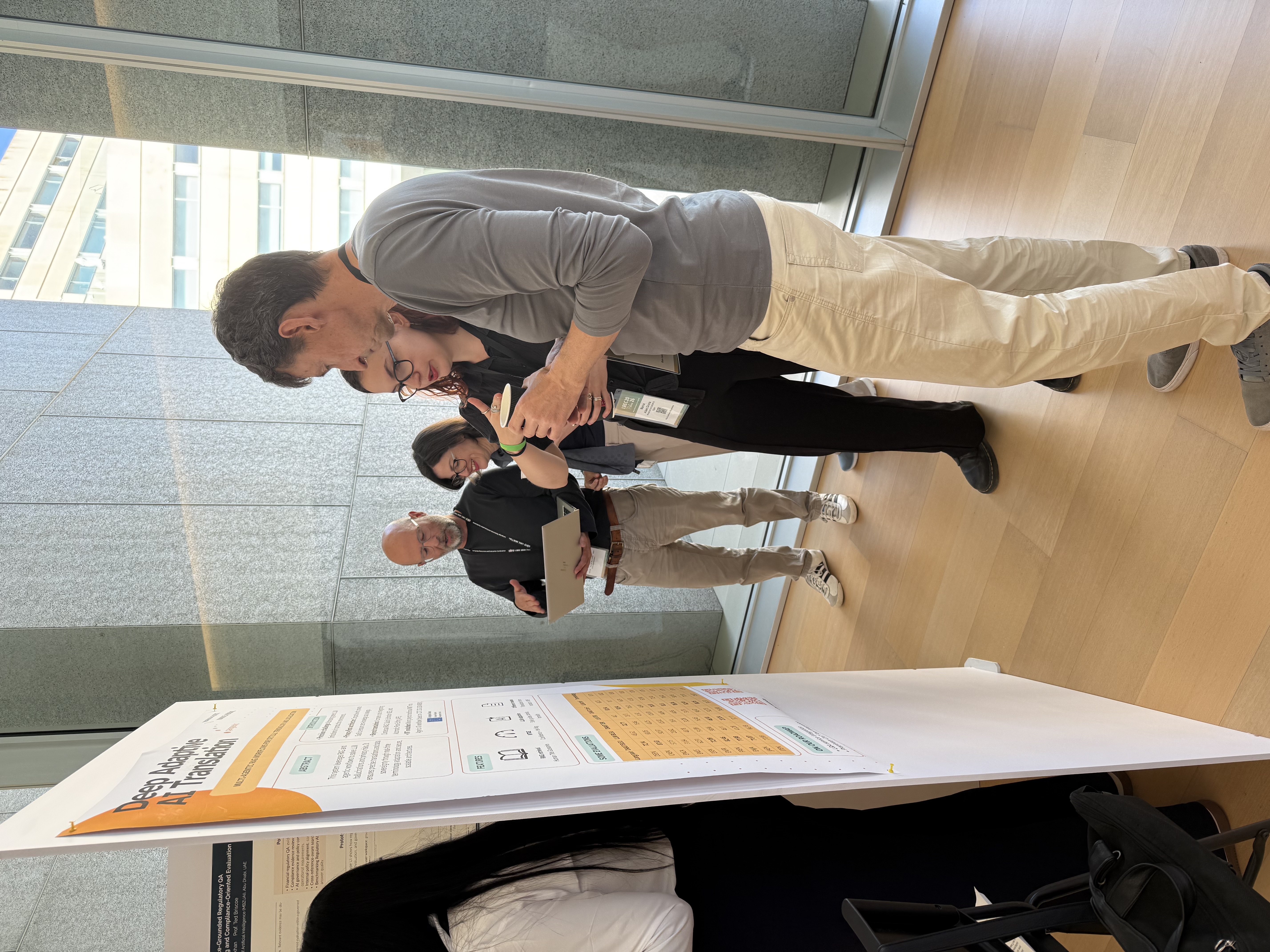
During the Industry Day, Marina Albert and I presented Deep Adaptive AI Translation, or DAAIT. The work examines how enterprise translation systems can combine generative models, retrieval, specialized language resources, terminology, quality estimation, and corrective feedback inside a controlled production architecture.
Translation provides a particularly demanding test for enterprise AI. A plausible sentence is insufficient when a system is handling tax documentation, technical instructions, medical information, legal terminology or manufacturing content. The output must preserve meaning, terminology, context and institutional intent across languages.
Deep Adaptive AI Translation addresses this problem by treating translation as a continuously evaluated process rather than a single model prediction. The architecture can incorporate client terminology, translation memories, domain corpora, retrieval, automatic post-editing, human feedback and Machine Translation Quality Estimation.
The resulting system can route content according to risk and predicted quality, apply corrective processes when confidence falls below a threshold and use production feedback to improve subsequent output. This approach is particularly relevant for organizations that require secure deployment, traceability and strict control over multilingual communication.
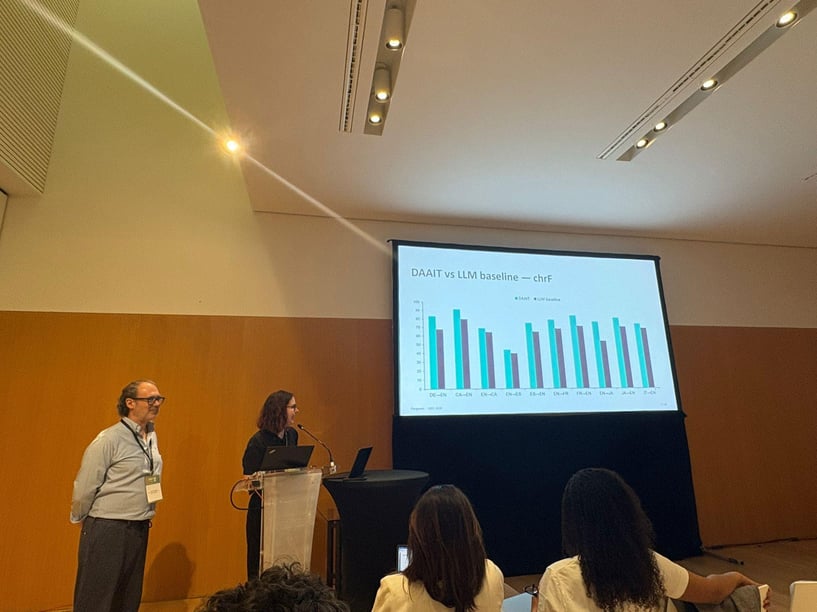
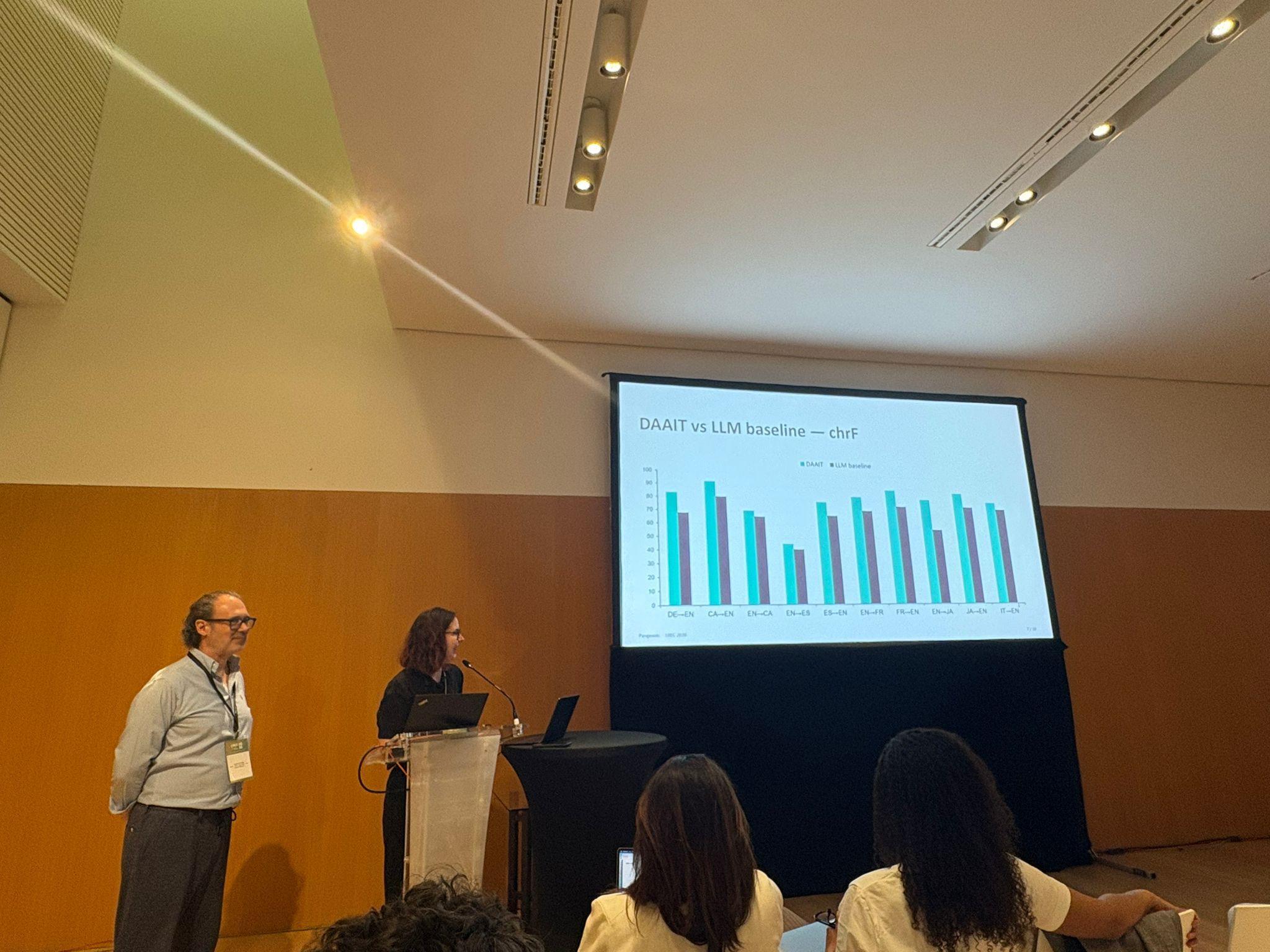
Pangeanic’s research trajectory in this area extends from early statistical machine translation and neural adaptation to current work on multi-agent translation, automatic post-editing and predictive quality control (MTQE) acting as a Trust Layer. The presentation connected that history with a broader enterprise requirement: placing a measurable trust layer between AI-generated language and operational workflows.
The rise of foundation models briefly encouraged the idea that sufficiently large general-purpose systems could absorb most linguistic complexity. LREC 2026 offered a more exacting picture. Language-specific, domain-specific, and culturally representative resources remain fundamental when AI must operate beyond high-resource languages and generic internet content.
Pangeanic began collecting and processing multilingual data for machine translation systems long before the current generative AI cycle. That work produced billions of aligned segments and gave us direct experience with the difficult parts of multilingual data: provenance, normalization, alignment, language variation, terminology, representativeness, and quality control.
The underlying engineering problem has changed in scale, but its structure remains recognizable. Dependable multilingual AI requires carefully prepared resources, including:
These assets serve several purposes. They help train and adapt models, reveal weaknesses hidden by aggregate benchmarks, support retrieval and grounding, and provide the evidence required to decide whether a system is ready for deployment.
This is also where Pangeanic’s history in language resources connects directly with its current work in AI Data Operations. Training data, evaluation data, model feedback and production monitoring form a continuous operational system rather than a series of disconnected procurement exercises.
One of the most consequential discussions we held at LREC concerned the future of responsibly sourced AI data. The Mozilla Data Collective presented its approach during the Industry Day, immediately after our session on Deep Adaptive AI Translation.
Those conversations developed into a formal relationship. Pangeanic subsequently joined Mozilla Data Collective as an early data provider, with the aim of making selected multilingual, multicultural, and multimodal resources available through its emerging data marketplace.
Mozilla Data Collective is developing a framework through which data owners and specialist providers can define access and licensing conditions while participating in the economic value generated by their resources. The initiative responds to a structural imbalance in the AI economy: valuable data is often separated from the communities, organizations, and experts that created it.
Pangeanic now has a public organization profile on the Mozilla Data Collective platform. At the time of publication, our selected datasets are still being prepared for public release and are not yet listed for download. That distinction is important because responsible publication requires more than uploading files. Licensing, provenance, documentation, privacy, permitted uses and dataset limitations must be clear before an asset is distributed.
The collaboration creates a new route for selected Pangeanic resources to reach model builders, researchers and enterprises while maintaining stronger control over attribution and commercial conditions. It also reinforces a wider industry development: curated datasets are becoming long-term infrastructure assets for specialized AI.
View Pangeanic’s organization profile on Mozilla Data Collective
LREC also led to a more formal European commitment. Following our discussions with representatives of ALT-EDIC, Pangeanic joined the Alliance for Language Technologies European Digital Infrastructure Consortium.
ALT-EDIC brings together European public institutions, research organizations and industrial participants around shared language technology infrastructure. Its scope is especially relevant to multilingual datasets, language resources, evaluation, model development and the capacity of European institutions to support their own linguistic and technological requirements.
Marina Albert represented Pangeanic at the subsequent ALT-EDIC industry meeting in France. Her participation extended the conversations begun in Mallorca and connected our technical work in multilingual data, machine translation, model evaluation and alignment with a broader European infrastructure effort.
The sequence is significant: a conference discussion led to consortium membership and then to active technical and institutional participation. LREC continues to perform this function particularly well, connecting scientific work with the organizations that can turn it into shared infrastructure, funded programs and production systems.
For Pangeanic, participation in ALT-EDIC also reflects a long-standing European orientation. Our work has included multilingual resources, translation infrastructure, anonymization, cultural data and AI projects involving public administrations, research centers and European institutions.
The need for rigorous human testing was also central to the LREC Industry Day panel on the growing pains of large language models for industrial practitioners. I participated alongside Adrian de Wynter of Microsoft and other industry specialists.
The panel addressed a recurring difficulty in enterprise AI: systems may perform well in general demonstrations while failing on the narrow linguistic, procedural, or security requirements of an actual organization.
Human evaluation remains indispensable because many operational failures are contextual. A model may produce factually plausible output while violating terminology rules, omitting a legal qualification, changing an instruction, adopting the wrong linguistic register or responding with unwarranted certainty.
These problems cannot always be captured by a single automated score. They require structured testing, expert review, representative user scenarios and feedback mechanisms such as model alignment and Reinforcement Learning from Human Feedback.
The discussion reinforced a principle already visible across Pangeanic’s projects: evaluation should be designed around the task, language, users and risk environment in which a model will operate.
Following our DAAIT presentation, we held discussions with Savana AI about the linguistic and architectural challenges surrounding healthcare data.
Medical information is frequently distributed across hospital systems that use different databases, formats, and clinical conventions. Translation adds another layer of complexity because patient records, reports and terminology may need to move between languages without exposing sensitive information or altering clinical meaning.
In this environment, data security and privacy are architectural requirements. Translation and language processing may need to operate on premises, in controlled private infrastructure or through systems that combine multilingual anonymization and data masking with tightly governed access.
Healthcare illustrates a wider enterprise problem. AI systems must interact with fragmented information while preserving domain accuracy, confidentiality and traceability. Model performance is only one component. The full data and operational architecture determines whether the technology can be used safely.
Beyond the Industry Day, presentations and posters from institutions including MBZUAI, the University of Montreal, the University of Tokyo and the University of the Basque Country offered a broad view of current multilingual AI research.
Several technical directions were especially relevant to enterprise systems.
A presentation led by Fondazione Bruno Kessler examined whether agentic Retrieval-Augmented Generation produces sufficient gains to justify its additional complexity. Agentic retrieval can improve planning and intent handling, but it may also increase latency, cost and sensitivity to model or retrieval changes.
Adaptive chunking offers one way to improve the quality of the information supplied to the agent. Documents are segmented according to their semantic structure rather than divided into arbitrary blocks of uniform length. Better initial segments can reduce retrieval noise and improve the relationship between the question, the retrieved evidence and the final response.
These findings align with several design choices in Deep Adaptive AI Translation, where retrieval quality, domain context and linguistic resources influence the output before quality estimation and corrective processes are applied.
Model merging attracted attention as a parameter-efficient method for multilingual adaptation. Language-specific model weights can be combined with an existing model, allowing researchers to extend linguistic capabilities without repeating a complete training or fine-tuning cycle.
This approach may reduce compute requirements and support smaller, more specialized models. It also reflects a broader move away from the assumption that every enterprise task requires a single general-purpose model of maximum scale.
Open projects such as FREC explored how Model Context Protocol infrastructure can make AI resources and tools more accessible within regional digital ecosystems.
Interoperable protocols can lower integration barriers for small and medium-sized enterprises, allowing specialized models, retrieval systems, databases and operational tools to communicate through more consistent interfaces.
The value of MCP will depend on governance, identity, permissions and evaluation. Connecting more systems creates useful capabilities, but it also expands the number of interfaces through which incorrect, sensitive or poorly governed information can travel.
Dan Jurafsky’s keynote, The Social Failures of Language Models as Conversational Partners, offered one of the most important conceptual reframings of the conference.
Jurafsky examined several ways in which conversational models can fail socially, including overconfidence, covert bias, sycophancy and poor reasoning about another person’s beliefs. These behaviors influence how users interpret and rely on a system, even when its individual answers appear fluent.
Evaluation must therefore consider the effect of model behavior on the human user. Accuracy and efficiency remain necessary, but they do not describe whether a system encourages unwarranted trust, reinforces stereotypes or simply agrees with the user to preserve conversational harmony.
This perspective is particularly relevant for public services, healthcare, education and other environments in which language models may influence decisions or shape a person’s understanding of complex information.
The broad conclusion from LREC 2026 is that dependable enterprise intelligence will be built through data quality, evaluation, and operational discipline.
Models will continue to improve, but organizations cannot outsource every requirement to the next model release. Their terminology, documents, policies, languages, user expectations and acceptable risk thresholds remain specific to their operations.
Enterprises therefore need a trust layer between model generation and business action. That layer may include:
Together, these capabilities form the operational discipline Pangeanic describes as AI Data Operations. The purpose is to keep data, evaluation, alignment, and production behavior connected throughout the lifecycle of an AI system.
Predictive quality estimation performs a central role in translation because it converts model confidence and observed quality into operational decisions. Content can be accepted, corrected, routed for human review, or returned to an adaptive process according to measurable thresholds.
The same principle extends beyond translation. Organizations deploying specialized language models need to know when a system performs adequately, where it fails, how those failures vary by language or domain, and what evidence should trigger intervention.
LREC’s full name contains two concepts that remain unusually prescient: resources and evaluation.
Language resources supply the linguistic evidence from which systems learn. Evaluation determines whether those systems behave adequately for a particular purpose. AI Data Operations connects both disciplines with governance, deployment, and continuous improvement.
This continuity is important for Pangeanic. Our early work in parallel corpora and machine translation data led to multilingual engines, adaptation, anonymization, model alignment, human feedback and quality estimation. The technologies have evolved, but the central question remains: how can language intelligence be made useful, measurable and dependable in the real world?
LREC 2026 showed that this question now occupies a much larger part of the AI industry. Multilingual data, human evaluation and secure deployment have moved from specialist concerns to core enterprise architecture.
The organizations that build these capabilities now will be better prepared for a market increasingly shaped by task-specific models, regulated data and AI systems expected to produce measurable results rather than persuasive demonstrations.
19 min read
Marina Albert Girona: 06/09/26
11 min read
 Manuel Herranz: 07/31/26
11 min read
Manuel Herranz: 06/14/26