

13 min read
 Manuel Herranz: 05/10/26
Yes, tokens can be the new, cheap coal, but Sovereign AI cannot be built on captive consumption. Palantir's CTO Shyam Sankar declared on the Q1...
10 min read
29/07/2026
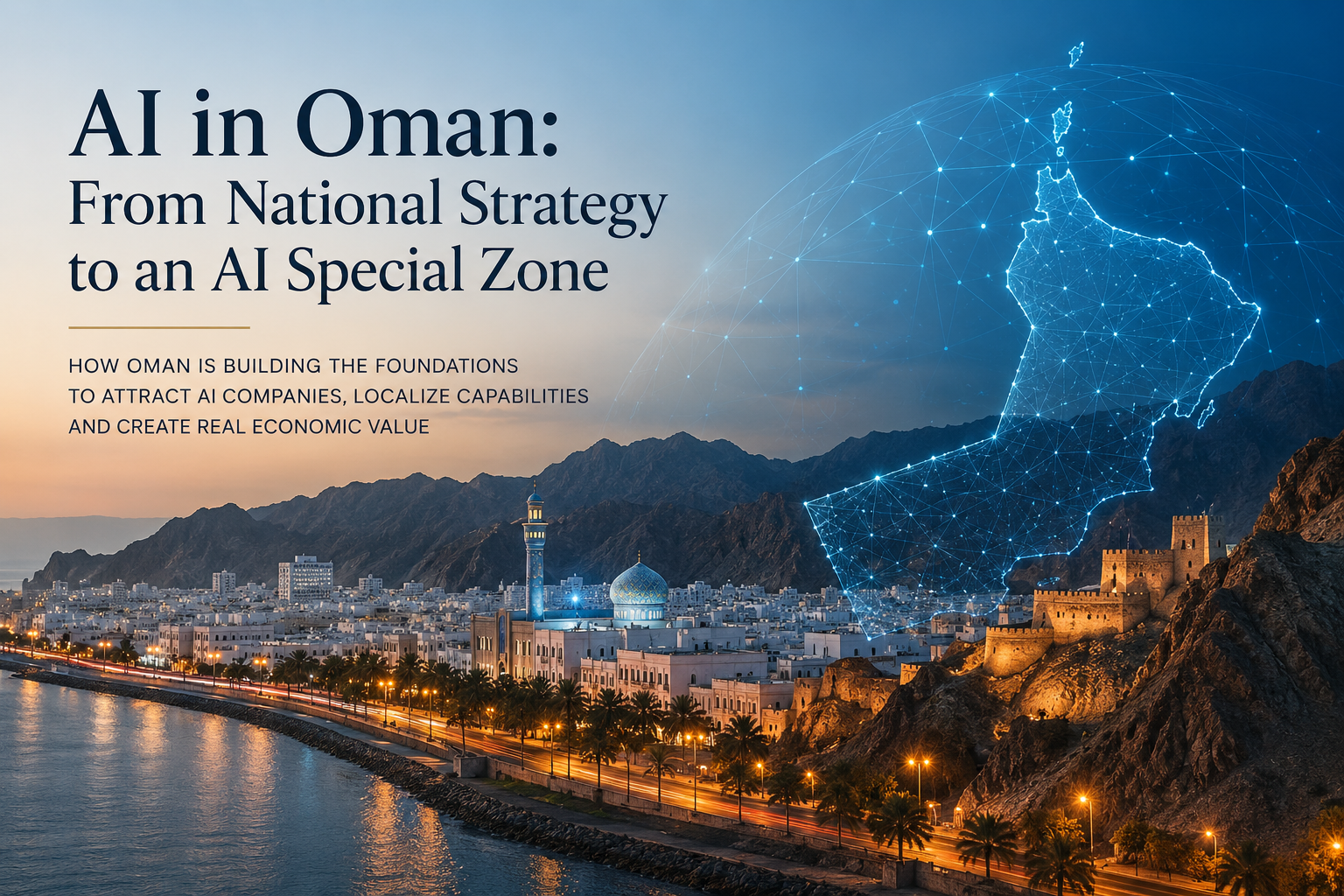
Oman has moved from policy statements to institutional infrastructure. The creation of an Artificial Intelligence Special Zone in Muscat gives the country a concrete uvehicle for attracting technology companies, localizing advanced capabilities and connecting artificial intelligence with its broader economic diversification program.
Oman will not outspend the United Arab Emirates or Saudi Arabia in the global race for artificial intelligence. Its opportunity lies elsewhere. The Sultanate can offer a stable, well governed and strategically positioned environment for companies that want access to the Gulf without entering the region through its largest and most crowded technology markets.
That distinction is important. The Gulf AI conversation is often reduced to sovereign funds, data centers and ever larger computing clusters. Compute is indispensable, but national AI capacity also depends on language data, domain knowledge, evaluation, governance and the ability to make systems perform reliably inside ministries, hospitals, industrial companies and regulated enterprises. Oman’s policy direction increasingly recognizes that wider architecture.
On April 30, 2026, Royal Decree 50/2026 established an Artificial Intelligence Special Zone in the Governorate of Muscat. The decree placed its development under the Public Authority for Special Economic Zones and Free Zones, working with the Ministry of Transport, Communications and Information Technology. Projects established in the zone are to receive the incentives, advantages, exemptions and facilities available under Oman’s law governing special economic zones and free zones.
The announcement gave physical and legal form to a policy that had been developing for several years. Oman’s National Program for Artificial Intelligence and Advanced Digital Technologies, covering 2024 to 2026, set out three broad objectives: increasing the adoption of AI in economic and development sectors, localizing advanced digital technologies and governing AI applications through a human centered approach. The program sits within Oman Vision 2040, the country’s long term reference for economic and social planning.
The AI Special Zone therefore deserves to be read as part of a sequence rather than as an isolated announcement. Oman is building policy, investment capacity, institutional governance and a designated location for companies. The next question is whether it can translate these foundations into useful AI systems, local capabilities and businesses that address real economic needs.
National AI strategies are easy to publish and difficult to implement. They often contain the same vocabulary: innovation, talent, investment, productivity and responsible use. The quality of a strategy becomes visible when governments begin assigning institutions, creating budgets, defining legal mechanisms and giving companies a place to operate.
Oman has now taken several of those steps.
The 2024 to 2026 national program identifies AI adoption, localization and governance as its central pillars. The language is revealing. Oman is not presenting artificial intelligence solely as imported software or a collection of public sector pilots. Localization appears as a national objective, alongside infrastructure, research, talent and public private cooperation. Governance is also embedded at program level rather than added as an afterthought.
The AI Special Zone advances that agenda by giving OPAZ and the Ministry of Transport, Communications and Information Technology a shared institutional role. According to OPAZ, the zone is intended to accelerate innovation projects, attract local and international AI companies, support startups and contribute to the digital economy under the 2026 to 2030 five year plan.
This does not yet answer every practical question. The decree establishes the zone and its legal basis, while many operational details will depend on the appointed developer, the eventual incentive package, infrastructure readiness and the first companies that commit to it. Still, the policy signal is considerably stronger than another conference or memorandum of understanding. A special economic zone creates a durable institutional object around which investment, regulation and commercial activity can be organized.
Comparisons with the UAE and Saudi Arabia are inevitable, but they can obscure Oman’s own strategic logic.
Abu Dhabi has used sovereign capital, research institutions and large technology groups to establish a formidable AI ecosystem. Saudi Arabia is coupling national transformation, public procurement, data infrastructure and large scale investment with an ambition to create regional and global technology champions. Both markets possess financial and institutional resources that Oman cannot realistically match.
Oman does not need to reproduce either model.
Its comparative advantages include political stability, a long tradition of pragmatic diplomacy, access to Indian Ocean trade routes, proximity to GCC markets and an economic diversification strategy that already gives importance to logistics, energy, manufacturing, tourism and digital services. These sectors generate concrete AI requirements. They require systems for document intelligence, multilingual communication, predictive maintenance, customer service, regulatory analysis, safety, knowledge retrieval and operational decision support.
Oman can therefore compete through selectivity. It can become attractive to companies that provide applied AI, domain specific models, multilingual systems, data infrastructure, evaluation and secure deployment. That is a more credible proposition than attempting to win a general race for the largest model or the largest compute cluster.
The Oman Investment Authority also provides evidence that technology and AI infrastructure form part of the country’s investment thinking. In May 2026, OIA announced a partial exit from its investment in Crusoe, a company active in AI infrastructure, reporting a tenfold return while retaining exposure to future growth. OIA has described technology transfer and the attraction of foreign investment as part of the “Omani angle” applied to selected international investments.
These signals suggest a dual approach: invest globally in advanced technology while creating domestic structures capable of absorbing knowledge, companies and commercial activity. The AI Special Zone can become one of those domestic structures, provided that it develops beyond real estate and incentives.
Special zones succeed when they reduce friction and create a concentration of capabilities. Tax benefits and regulatory facilities may attract initial attention, but technology companies also need access to customers, technical talent, data, research partners, local integrators and predictable procurement processes.
For the Muscat AI Special Zone, five questions will be decisive.
AI companies rarely relocate because of incentives alone. They need buyers. Oman’s ministries, state owned companies, banks, logistics operators, utilities, energy companies, tourism organizations and healthcare providers could provide a strong domestic demand base. The zone will acquire commercial gravity if it creates structured access to these organizations and helps convert their operational problems into procurement opportunities.
Running a foreign model on infrastructure located in Oman offers some control over data and deployment. Localization becomes more substantial when systems are adapted to local language, terminology, law, institutional procedures and sector specific knowledge. An AI assistant used by an Omani ministry should understand its documents, administrative vocabulary and bilingual workflows. A system used in energy or logistics should be evaluated against the tasks and risks of those environments.
Every national AI strategy encounters the same practical barrier: valuable data exists inside organizations, but it is fragmented, sensitive, multilingual, inconsistently structured or difficult to license. Oman’s national program includes an open data platform, which can support entrepreneurship and research. Enterprise and government AI will also require governed pipelines for private data, anonymization, cleaning, annotation, terminology and evaluation.
Many Omani use cases will not require a general purpose model with hundreds of billions of parameters. Ministries and enterprises often need compact systems adapted to a narrow task, deployed privately and evaluated against a defined risk threshold. Small and specialized models can be more economical, more controllable and easier to operate in environments where data cannot leave the organization.
The growing interest in task specific models also changes the economic structure of national AI programs. A country does not need to train a frontier model for every administrative, industrial or linguistic task. It needs access to suitable base models, strong local data, evaluation methods and the capacity to adapt systems safely. This approach directs investment toward the assets that remain valuable when model generations change.
AI adoption slows when organizations cannot determine whether an output is reliable. Trust cannot depend on a vendor presentation or a model’s confidence score. It requires test data, human validation, domain criteria, error analysis and continuous evaluation after deployment. The countries that develop evaluation capacity will be better placed to distinguish useful AI from impressive demonstrations.
Oman’s AI ambitions will eventually encounter the structure of Arabic itself.
Arabic is frequently treated as a single language category in datasets and model documentation. Operational reality is more intricate. Modern Standard Arabic is used across formal writing, regulation, education, media and public administration. Spoken communication varies by country, region, generation, social context and professional environment. English is common in business and technical settings, and code switching appears naturally in conversations, customer service, healthcare and corporate communication.
Omani Arabic also contains regional variation and vocabulary shaped by the country’s history and geography. A system trained predominantly on Modern Standard Arabic, Egyptian media content or Gulf data from another country may perform acceptably on broad tasks while failing on local speech, named entities, institutional terminology or culturally specific expressions.
This gap affects several AI categories:
These are data and evaluation problems as much as model problems. They require representative datasets, bilingual assets, terminology, local review, carefully designed test sets and feedback from production use.
Pangeanic has worked with multilingual data and language technologies for more than twenty five years. Our current Arabic datasets for AI training capabilities cover the data layer required to train, adapt and evaluate systems across text and speech use cases. Our broader datasets for AI work includes sourcing, licensing, collection, annotation and quality control for model development and evaluation.
The commercial opportunity in Oman is therefore wider than supplying an Arabic corpus. Organizations will need data that reflects their task, dialect, domain and deployment environment. They will also need a method for determining whether the resulting system performs well enough to use.
Machine translation offers a useful example because it exposes the weaknesses of generic evaluation very quickly.
A translation can be grammatically fluent and still be unsuitable for use. It may mistranslate a legal concept, ignore approved terminology, flatten a regional expression or select a phrase that sounds foreign to the intended audience. Traditional benchmark scores provide useful comparisons at model level, but enterprises need to know whether each output can move through a production workflow safely.
This is the reasoning behind adaptive machine translation quality estimation. MTQE evaluates a translation without requiring a human reference for every sentence. An adaptive layer can combine model signals with language pair, domain, terminology, bilingual assets and previous corrections. The output can then be routed according to confidence: accepted, flagged for review or sent for deeper human validation.
For Arabic, that approach becomes especially relevant. Quality thresholds may differ between formal Modern Standard Arabic, a customer service exchange, technical documentation and content intended for a particular Gulf audience. Terminology can carry commercial, regulatory or safety consequences. A static benchmark offers a snapshot; an adaptive quality layer accompanies the system while it works.
Pangeanic’s work in machine translation quality estimation and AI machine translation is moving toward this operational model: translation, evaluation, routing, human review and continuous adaptation connected within the same production environment.
Oman can benefit from the same principle beyond translation. AI systems used in public administration, industry or regulated services require a trust layer that measures performance in context. The exact method changes by task, but the architecture remains recognizable: local data, defined criteria, continuous evaluation and human intervention where risk demands it.
The strongest opportunities are likely to emerge where AI supports sectors already central to Oman’s diversification strategy.
Government organizations manage large volumes of Arabic and English documents, citizen inquiries, internal knowledge and administrative procedures. Applied AI can support classification, search, summarization, translation, anonymization and assisted drafting. These systems require controlled access, traceability and reliable retrieval from authoritative sources.
Energy, petrochemicals, mining and industrial companies generate technical documentation, maintenance records, safety procedures and operational data. Specialized models can help engineers retrieve knowledge, compare incidents, analyze maintenance histories and work across multilingual documentation. Accuracy and provenance are more valuable here than conversational fluency.
Oman’s geographic position gives logistics a strategic role. AI can support document processing, customs workflows, demand forecasting, multilingual communication and operational planning. The commercial value comes from integration with existing systems and measurable reductions in delay or manual work.
Tourism creates demand for multilingual information, search, customer service and content adaptation. Systems need to handle Arabic and international languages while representing Omani places, institutions and cultural references accurately. Generic travel content generated from weak sources would damage rather than strengthen the visitor experience.
Banks, insurers and regulated enterprises require document intelligence, customer communication, compliance review and secure internal assistants. These use cases favor private deployment, auditable data flows and carefully defined evaluation.
Healthcare AI must operate across clinical terminology, patient language, privacy rules and high consequences for error. Speech, translation, transcription and document extraction all require local validation. The ability to process Arabic and English safely can become a practical differentiator for providers and technology partners.
The creation of a special zone may encourage international companies to look at Oman for the first time. A credible market entry proposition should go beyond presenting a global product and requesting government introductions.
Companies should be prepared to answer several questions.
The last question is particularly important. Oman’s policy language emphasizes localization. A company that creates local data assets, trains Omani specialists, collaborates with universities or transfers evaluation methods will offer more strategic value than a vendor that merely resells access to an external API.
European AI companies can have a useful role here. Europe has accumulated experience in multilingual technology, privacy, regulated deployment and public sector procurement. Those capabilities align with Oman’s stated interest in human centered governance and local capacity. European providers will still need commercial discipline, local relationships and a clear understanding of Gulf procurement. European origin alone does not create relevance.
The Muscat AI Special Zone is an important institutional step, but its long term value will depend on the operating environment that develops around it.
A successful AI ecosystem requires several layers:
This is the field Pangeanic describes as AI Data Operations. It connects raw information with model behavior and production performance. The model remains important, but organizations experience AI through the quality of the complete system.
For Oman, this wider view can help avoid a familiar problem. Countries can invest heavily in infrastructure and still depend on foreign systems that perform poorly on local language, local processes and local knowledge. Building national capacity requires control over the data and evaluation layers, even when the underlying model comes from an international provider.
Oman has now established the basic elements of a serious AI proposition: a national program, a governance orientation, an investment institution active in technology and a dedicated special zone in Muscat. These steps support the conclusion that the Sultanate intends to participate actively in the Gulf’s AI economy.
It would still be premature to describe Oman as an equivalent competitor to the UAE or Saudi Arabia. The scale of capital, research institutions, procurement and infrastructure remains different. Oman’s more plausible path is to become a focused regional location for applied AI, specialized companies and commercially useful systems connected to its diversification priorities.
That path may prove more durable than a race based on announcements alone.
The next phase will reveal whether the AI Special Zone attracts companies that build local capability, whether Omani organizations become accessible early customers and whether data, language and evaluation receive the same attention as compute. Arabic AI will provide one of the clearest tests. A system that cannot understand local users, documents and terminology cannot become national infrastructure, regardless of the model used beneath it.
Oman has created the institutional door. The companies that enter successfully will be those prepared to work on the less theatrical layers of artificial intelligence: data, adaptation, integration, measurement and trust.
Pangeanic supports governments, enterprises and AI developers with Arabic datasets, multilingual AI Data Operations, machine translation, evaluation, terminology, anonymization and secure deployment workflows.
Discuss an Arabic AI, evaluation or language data requirement with Pangeanic.
13 min read
Manuel Herranz: 05/10/26
16 min read
Manuel Herranz: 06/13/26
26 min read
 Yash Dhobale: 05/02/26