

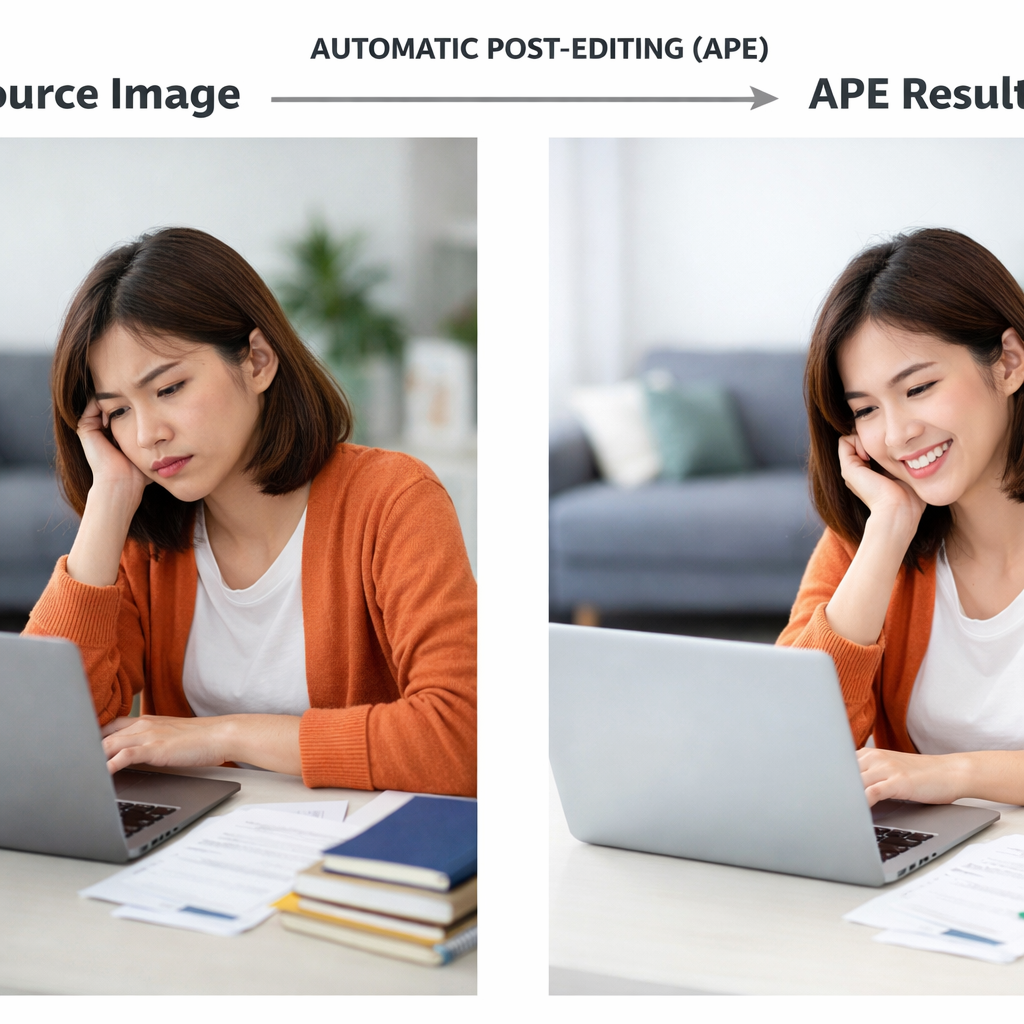
Most organizations are not deciding whether to use AI in translation. They are deciding how much control they are willing to give up in exchange for speed.
This is the real distinction between human post-editing, LLM-based editing, and Automatic Post-Editing (APE). These are not interchangeable techniques. They represent different approaches to quality, terminology control, workflow visibility, and operational risk.
In enterprise translation, the question is not which approach sounds more advanced. The question is which one fits the content, the compliance requirements, and the production systems already in place.
Three ways to improve machine translation output
Once machine translation produces an initial output, organizations typically rely on one of three methods to improve it before delivery.
Human post-editing involves professional linguists correcting machine translation output manually. This remains the reference standard for high-quality, publishable content.
LLM-based editing uses large language models to rewrite or polish translation output, usually focusing on fluency and readability.
Automatic Post-Editing (APE) applies AI-driven correction in a controlled workflow, often using translation memory, terminology rules, and quality estimation to improve output before selectively involving human reviewers.
Human post-editing: maximum control, limited scalability
Human post-editing provides the highest level of control over translation output. Linguists can interpret context, resolve ambiguity, enforce terminology, and adapt tone to specific audiences.
This makes it essential for:
- Legal and regulatory content
- Medical and safety-critical documentation
- Brand-sensitive or public-facing communication
- Complex multilingual content with low repetition
However, human post-editing does not scale efficiently. As content volume increases, organizations face predictable constraints:
- Higher cost per word
- Longer turnaround times
- Difficulty maintaining consistency across distributed teams
In high-volume environments, much of the effort goes into correcting repetitive or predictable errors rather than adding real linguistic value.
LLM editing: fluency without workflow control
LLM-based editing has gained attention because of its ability to produce fluent, natural-sounding text. It can quickly improve readability and restructure awkward machine translation output.
In practice, however, LLM editing introduces a different set of trade-offs.
Most implementations operate without direct integration with translation memory, terminology databases, or enterprise workflow controls. As a result, LLM editing often:
- Improves fluency but weakens terminology consistency
- Introduces variability across similar segments
- Lacks traceability and auditability
- Requires additional human review to validate changes
For non-critical or exploratory content, this may be acceptable. In regulated or terminology-sensitive environments, it increases operational risk rather than reducing it.
Automatic Post-Editing (APE): structured automation with control
APE sits between human expertise and generic AI rewriting. Its value comes from structure.
Rather than rewriting output in isolation, APE operates within a workflow that can incorporate:
- Translation memories (TMX, CSV, TSV)
- Terminology and glossary constraints
- Retrieval of prior approved translations
- Machine Translation Quality Estimation (MTQE)
- Controlled routing to human review
This makes APE particularly effective in environments where translation is:
- Repetitive and structured
- Terminology-heavy
- High-volume and time-sensitive
- Part of an ongoing multilingual production workflow
In these contexts, APE does not replace human expertise. It reduces the amount of repetitive correction work required before human review is applied.
The role of MTQE in modern APE workflows
One of the key differences between APE and other approaches is the use of quality estimation.
Machine Translation Quality Estimation (MTQE) predicts the quality of translation output without requiring a human reference translation. This allows systems to classify segments based on risk before they reach a linguist.
In practice, this enables:
- Selective human review instead of blanket post-editing
- Faster throughput on high-confidence content
- Better allocation of linguistic resources
- Measurable control over quality thresholds
Without MTQE, APE becomes a blind correction layer. With it, APE becomes part of a controlled decision system.
Comparison: APE vs Human vs LLM editing
|
Criteria |
Human PE |
LLM Editing |
APE |
|---|---|---|---|
|
Control |
Very high |
Low |
High (workflow-based) |
|
Scalability |
Limited |
High |
High |
|
Terminology consistency |
High |
Variable |
High |
|
Workflow integration |
Strong |
Weak |
Strong |
|
Best use case |
Critical content |
Low-risk content |
High-volume structured content |
What enterprises are actually doing
In practice, organizations do not choose a single method. They combine them.
A typical enterprise workflow looks like this:
- Machine translation for initial output
- APE to improve predictable patterns and reduce correction effort
- MTQE to classify segments by risk
- Human review for low-confidence or critical content
LLM-based editing may be used selectively, but rarely as the primary system of record for production workflows.
This hybrid approach reflects a simple reality: different types of content require different levels of control.
Case example: from repetitive correction to structured workflows
In large-scale deployments such as automotive localization, the challenge is rarely translation itself. It is the volume of repetitive correction required after translation.
In projects such as BYD AUTO JAPAN, combining domain-adapted models, retrieval-based adaptation, and automated post-editing reduced translation turnaround time by approximately 70% while maintaining terminology consistency across large content volumes.
The key was not replacing translators. It was reducing the amount of avoidable correction work before human review.
The path forward
The future of enterprise translation is not a single model or a single technique. It is a layered workflow.
Organizations that succeed will not be those that adopt the most powerful models, but those that design the most appropriate workflows for their content.
- Human expertise remains essential for high-risk and high-value content
- APE enables efficiency in structured, repeatable workflows
- Quality estimation allows review to be selective rather than uniform
The question is no longer whether AI can improve translation. It is how to integrate it without losing control.
If your organization already manages translation memory, terminology, and multilingual production at scale, the opportunity is clear: reduce avoidable human effort while keeping quality where it matters.


