

26 min read
 Yash Dhobale: 05/02/26
AI Training Data The best AI training data provider depends on the system being built. Appen is a strong fit for large global data collection,...
14 min read
25/07/2026
Enterprise AI is no longer bought on annotation volume. It's bought on evaluation capability. The same pattern shows up in many enterprise AI projects: the training data is annotated, the volume looks sufficient, and the benchmark scores are good. But as soon as the model goes into production, response quality drops noticeably in one language, one department, or one type of query. The overall score doesn't show it; the end user notices immediately. This gap sits behind many of the problems that appear when an AI project moves from pilot to production.
Behind this problem, it's often not the model itself but an evaluation phase that wasn't designed with enough rigor at the point the vendor was selected. Accurately labeled data is a necessary condition, not a sufficient one. What an enterprise actually needs is verifiable evidence that the model behaves in a stable way when language, department, or usage conditions change, with enough traceability to reproduce and explain the results.
This guide explains the seven criteria enterprise AI teams should use when choosing a multilingual AI training data partner for custom models. It also examines why evaluation capability has become the decisive factor in vendor selection, how multilingual quality can collapse locally even when aggregate scores look fine, and which questions buyers should ask before committing data, budget and model development time.
Picture an AI project built for a specific task: enough data volume, good benchmark scores. But once it's rolled out across different parts of the business, response quality drops noticeably in one language, one region, or a particular register (customer service versus internal communication, for example). It's a local collapse that the average score doesn't show.
In the traditional procurement model, the enterprise supplied raw data, the vendor returned labeled files, and model performance remained the responsibility of the technical team. That division is becoming obsolete. Custom AI systems are now expected to operate inside business processes, public services, industrial environments and regulated workflows. Once a system is embedded that deeply, splitting responsibility this way stops working — it hides the risk rather than managing it. The questions a procurement team should actually be asking a vendor are of a different kind:
Only once these questions can be answered does annotation stop being an isolated service and become part of a governed quality assurance process. The industry increasingly describes this operating discipline as AI Data Operations: a framework that connects data sourcing, annotation, privacy, evaluation, alignment and continuous improvement under a single quality control system.
An annotated dataset records human decisions at a particular moment. A production AI system keeps changing after that dataset has been delivered. Models are updated. Retrieval sources evolve. New terminology enters the domain. Users discover unexpected prompts. Policies change. New languages and markets are added. A once-reliable benchmark may stop representing the operational reality of the system.
Production-ready multilingual AI therefore needs a repeatable process rather than a static asset: representative data for each language and locale, explicit quality thresholds, evaluation sets separated from training data, human review protocols, failure categories and escalation rules, versioned benchmarks, and feedback loops connecting production failures to new training and evaluation examples. The difference resembles inspecting a machine once versus running a permanent quality system around it. Both involve measurement, but only one can detect deterioration over time.
This matters just as much for enterprises building models across several languages at once. The real challenge isn't sourcing data separately for each language — it's holding data standards, evaluation methods and quality thresholds consistent across markets. That calls for a partner able to cover multiple languages within one methodology for collection, annotation, model alignment and independent evaluation, rather than a different vendor per language. That kind of cross-lingual capability lowers the overhead of managing multiple suppliers and makes model performance genuinely comparable across languages, which is what makes it possible to catch local problems an aggregate average would otherwise hide.
Annotation quality determines what a model learns from human judgment. However, accuracy alone is an incomplete measure. Enterprise data must also be reproducible.
Two trained reviewers working from the same instructions should reach sufficiently consistent conclusions. When they disagree, the workflow should identify whether the cause lies in ambiguous guidelines, insufficient context, cultural interpretation or a genuinely difficult edge case.
High quality multilingual text annotation requires more than access to native speakers. It requires task design, domain knowledge, reviewer calibration, adjudication and quality analysis.
Language coverage should never be judged by counting names in a vendor list.
A provider may claim support for one hundred languages while possessing strong operational capacity in only a small group. Production depth depends on qualified reviewers, regional coverage, domain terminology, cultural knowledge and the ability to recruit or collect new data when existing resources are insufficient.
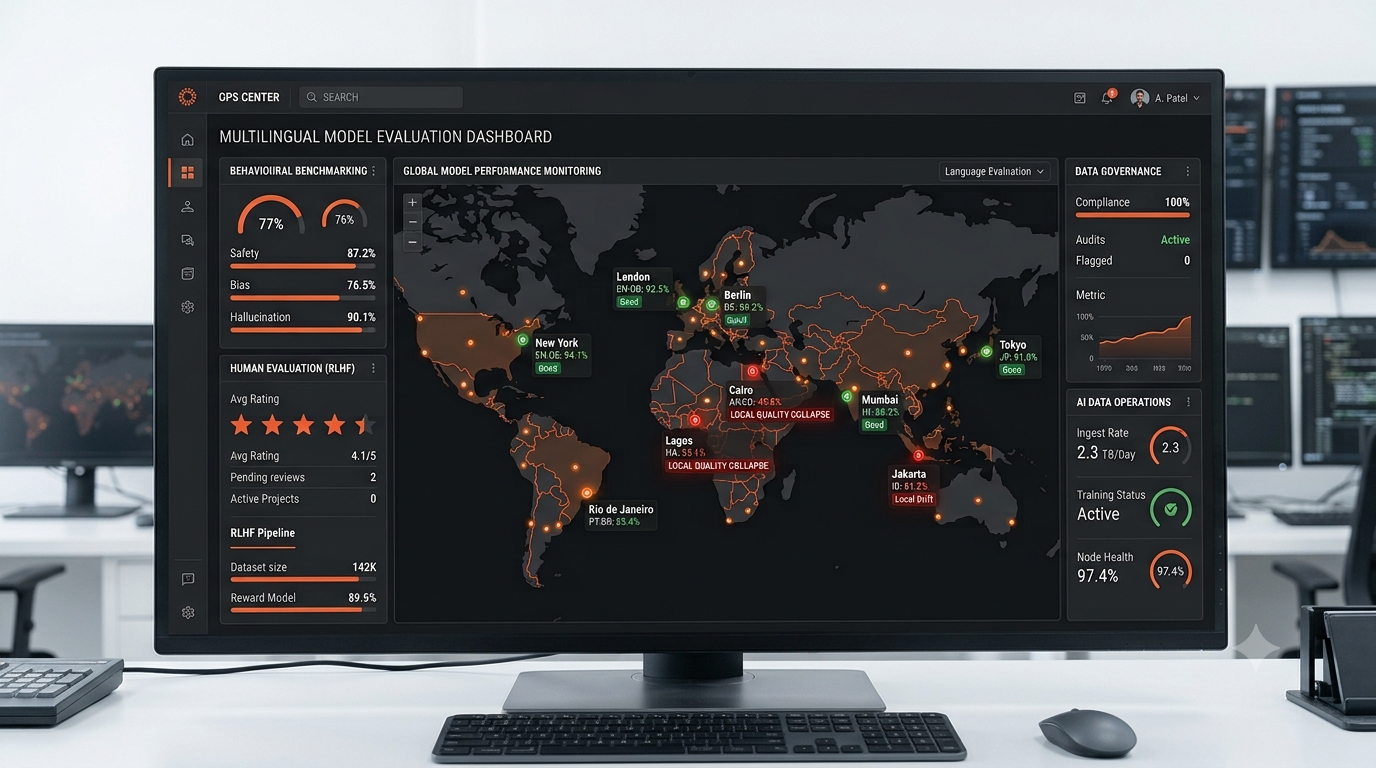
Multilingual AI also fails unevenly. A model may perform strongly in English, adequately in Spanish and poorly in a regional variety that disappears inside the average score. Pangeanic describes this phenomenon as Local Quality Collapse: severe factual, linguistic or behavioral degradation in a particular language, locale, domain or user group while aggregate performance remains acceptable.
This is highly relevant to enterprise deployment because users experience local performance, not global averages.
For geographically sensitive applications, geocentric data collection can structure training, evaluation and alignment data around a defined region, language community, physical environment and legal context.
AI data must be useful and legally defensible.
Enterprises should know where data originated, what rights permit its use, which transformations were applied and whether personal or confidential information remains inside it. The absence of that information can turn an apparently inexpensive dataset into a future legal, security or procurement problem.
Governance should cover the complete chain: source and ownership, consent or licensing basis, permitted purposes, retention rules, annotator access, transformations and filtering, dataset versions, and delivery and deletion.
Sensitive information may need to be removed before external review or model training. Pangeanic's multilingual data masking workflows identify and protect personal information across languages while preserving as much analytical utility as possible.
Some projects also require on premises, private cloud or air gapped processing. These deployment conditions should be discussed during data design rather than added after collection has begun.
Generic datasets are rarely sufficient for specialist enterprise behavior.
A model designed to classify insurance claims, search industrial manuals or assist a public administration needs examples drawn from that task, domain and operational vocabulary. Data preparation must begin with the model's intended behavior rather than with whichever dataset is easiest to acquire.
This becomes particularly important for small and domain specific models. Their advantage lies in concentration: they can be more efficient and controllable because their training and evaluation are focused on a narrower problem.
A suitable data partner should support: supervised fine tuning datasets, instruction and demonstration data, domain terminology, expert reasoning examples, retrieval and grounding corpora, hard negative examples, preference and alignment data, and task specific evaluation sets.
Parallel corpora remain highly valuable for translation, cross linguistic retrieval and multilingual model adaptation. Pangeanic's repository contains more than 10 billion aligned segments, combined with custom filtering, evaluation and domain adaptation workflows.
Enterprise AI is becoming multimodal. Text remains central, but many operational systems also interpret speech, images, video, scanned documents and structured metadata.
A provider that treats every modality as a variation of text annotation will miss the technical conditions that determine quality.
Speech projects require speaker metadata, diarization, segmentation, timestamp alignment, channel information, acoustic conditions, dialect and accent coverage, code switching annotation, and transcription conventions. Pangeanic provides ready to license and bespoke speech and audio datasets for ASR, conversational AI, transcription, voice systems and model evaluation.
Document and visual AI introduce other requirements: OCR transcription, reading order, page layout, tables, handwriting, image quality and the relationship between visual and textual information.
The essential question is whether the provider can reproduce the environment in which the model will operate. Studio speech alone will not evaluate a call center model. Clean digital documents will not prepare a system for damaged scans, handwritten notes or complex administrative forms.
A model can be linguistically fluent and operationally unsuitable.
It may provide unsafe advice, ignore policy, use an inappropriate register, reveal confidential information, refuse harmless requests or behave differently when the same instruction is expressed in another language.
Model alignment uses human judgment and structured evaluation to bring model behavior closer to the task, policy and cultural expectations of the organization.
Relevant data may include preferred and rejected responses, policy labels, safety classifications, expert corrections, instruction following examples, register and tone judgments, cultural appropriateness reviews, and adversarial prompts.
Multilingual alignment must be evaluated locally. Translating an English safety set into another language rarely captures the same cultural references, ambiguity, social roles or adversarial strategies.
Multilingual AI red teaming uses original prompts and multi turn scenarios to expose reasoning failures, hallucination, bias, unsafe compliance and inappropriate refusal across languages and policy boundaries.
Evaluation is the criterion that connects all the others, and one of the decisive factors in deciding whether a project can move into production.
Without independent measurement, a buyer cannot know whether better annotation, more data, additional fine tuning or human feedback has improved the system. A general benchmark may indicate broad capability, but it rarely represents the exact language, task, domain and risk conditions of an enterprise deployment.
AI evaluation and quality assurance should therefore be designed around operational behavior.
Traditional evaluation often reduces performance to a single score. Accuracy, BLEU, F1, win rate or another aggregate metric can be useful, but a single number may hide the failures most relevant to the organization.
Behavioral benchmarking evaluates whether a model performs the required actions and behavioral requirements reliably under representative conditions. It can measure factual correctness, instruction following, terminology consistency, language and register, safety policy compliance, appropriate refusal, robustness to ambiguity, resistance to adversarial prompts, consistency across languages, and performance on rare but costly edge cases.
This framework functions as an operational quality specification shared between the model and the organization. It defines what acceptable performance means before deployment and provides a stable reference when models, prompts or data sources change.
A benchmark should evolve as the system encounters reality.
Production failures can be reviewed, anonymized, classified and added to future evaluation suites. New terminology, policies and user patterns should also produce new test cases. This creates a continuous loop:
Production behavior → failure analysis → new evaluation data → model or workflow improvement → repeated evaluation
For machine translation, Machine Translation Quality Estimation can predict output quality without a human reference translation, providing an operational signal for routing weak output, comparing engines, filtering parallel data and constructing stronger multilingual evaluation sets.
Local Quality Collapse occurs when a multilingual AI system maintains acceptable aggregate results while suffering severe factual, linguistic or behavioral degradation in a particular language, locale, domain or user group.
The model may look healthy on a global dashboard because high volume English data dominates the average. Users of Valencian Catalan, Basque, Gulf Arabic, an African language or a regional Spanish variety may experience a fundamentally different system.
Local collapse can appear as incorrect factual answers in one language, unnatural or inappropriate register, higher hallucination rates, failure to recognize regional terminology, inconsistent safety behavior, excessive refusal in a low resource language, lower speech recognition accuracy for a particular accent, or retrieval systems that miss documents outside English.
The remedy is not simply more multilingual volume. Enterprises need evaluation sets that expose local failure, sufficient training or grounding data to address it, and continuous benchmarking to confirm that the intervention worked.
Read the full analysis in Why Multilingual AI Data Quality Is Hard to Get Right.
Procurement documents often contain impressive figures for language coverage, crowd size and completed annotations. Those figures say little about the provider's ability to deliver a reliable custom model.
Verification should begin with evidence.
Vendor comparisons are most useful when they examine verifiable operating capabilities rather than unsupported checkmarks. The following framework can be used during an RFI, RFP or pilot.
| Capability | Evidence to request | Risk if absent |
|---|---|---|
| Language depth | Samples, active reviewer availability and quality metrics for each target locale | Good average performance with severe local failures |
| Annotation reproducibility | Guidelines, agreement metrics, adjudication examples and audit records | Conflicting training signals and unstable model behavior |
| Data provenance | Source records, licensing basis, consent status and permitted use | Legal, procurement and model governance exposure |
| Privacy architecture | Anonymization workflow, access controls and deployment options | Exposure of personal, confidential or regulated data |
| Custom model readiness | Examples of fine tuning, grounding and task specific data specifications | Large datasets with weak relevance to the production task |
| Alignment capability | Preference workflows, policy labeling and multilingual red team methodology | Fluent models with unsafe or inappropriate behavior |
| Evaluation infrastructure | Benchmark sets reserved and separate from training data, failure taxonomies and model comparison reports | No reliable evidence that the data improved the model |
| Continuous improvement | Process for turning production feedback into new tests and training examples | Quality deteriorates as models and operational conditions change |
Pangeanic began collecting, aligning and processing multilingual data for machine translation systems more than two decades ago. That work produced large linguistic repositories, including more than 10 billion aligned segments, and an industrial capacity to evaluate language data across domains and language pairs.
On that foundation, Pangeanic has built an integrated AI Data Operations model that includes:
Pangeanic's track record spans three complementary areas: large-scale institutional deployment, data protection in regulated environments, and data preparation for training and evaluating language models.
Large-scale institutional deployment. Pangeanic's document translation services are used by more than 25,000 employees of the Agencia Estatal de Administración Tributaria (AEAT), Spain's tax agency, across geographically distributed teams.
Privacy and regulated environments. The MAPA multilingual anonymization workflows are used by Spain's Ministry of Justice and the European Commission's Directorate-General for Translation.
Research, evaluation and language models. Pangeanic has collaborated with the Barcelona Supercomputing Center (BSC), one of Europe's leading high-performance computing centers, on annotation, human feedback, evaluation and training data preparation for the Salamandra and ALIA language models.
For enterprises, AI labs and public administrations, the commercial value lies in having a single partner capable of connecting those layers. Data collection without evaluation provides volume. Evaluation without operational feedback provides a snapshot. AI Data Operations connects both into a system that can keep learning without losing control.
Multilingual AI training data services collect, prepare, annotate, govern and evaluate data used to train or adapt AI systems across languages. They may include text annotation, speech transcription, parallel corpora, terminology, instruction data, human preferences, evaluation benchmarks and red team scenarios.
Annotation services produce labels or judgments for a defined dataset. AI Data Operations connects data sourcing, preparation, annotation, governance, evaluation, alignment and production feedback throughout the model lifecycle. Annotation remains one component of the wider operating discipline.
Enterprises need evidence that a model performs the intended task safely and consistently. Evaluation datasets, behavioral benchmarks and human review show whether training or fine tuning has produced the desired behavior. Labels have limited value when their effect on the model cannot be measured independently.
Behavioral benchmarking tests whether a model performs required actions under representative conditions. It can evaluate factual accuracy, instruction following, terminology, safety, appropriate refusal, multilingual consistency and performance on high risk edge cases rather than relying on a single aggregate score.
Local Quality Collapse occurs when a multilingual AI system appears acceptable in aggregate but performs poorly for a particular language, locale, domain or user group. Separate evaluation by language and operational context is required to detect it.
The required data depends on the task. A custom model may need domain text, instruction examples, specialist terminology, retrieval documents, human preferences, adversarial prompts and independent evaluation sets. Task specific models benefit from data that closely represents their intended operating conditions.
Annotation quality can be assessed through expert review, inter annotator agreement, adjudication outcomes, gold standard checks and the effect of the resulting data on model evaluations run against a reserved, independent evaluation set. The appropriate metric depends on whether the task is objective, subjective or specialist.
Multilingual models should be evaluated separately by language, locale, domain and capability. Test sets should contain original language material and representative user scenarios rather than relying entirely on translations from English.
Sensitive data may be usable when governance, legal basis, access controls, anonymization and secure processing are designed correctly. Some organizations require on premises or air gapped workflows so that data remains within their own infrastructure.
Timelines depend on languages, volume, domain expertise, collection conditions, annotation complexity and evaluation requirements. Existing datasets may be licensed quickly, while low resource or specialist collections may require recruitment, pilot work and several production stages.
A useful pilot should include representative data, documented guidelines, quality metrics, provenance information and an evaluation set that is reserved and kept separate from the training data. The buyer should measure whether the resulting data improves the model against clearly defined operational behaviors.
Enterprise AI is no longer judged by annotation volume, but by evaluation capability, traceability and quality assurance that holds up over time.
Pangeanic helps enterprises, AI labs and public institutions build multilingual AI through trusted datasets, human evaluation, model alignment, privacy aware workflows and controlled deployment. Our work connects data acquisition with behavioral evidence, allowing organizations to improve models while retaining control over language quality, governance and operational risk.
Discuss your multilingual AI data and evaluation requirements with Pangeanic.
26 min read
Yash Dhobale: 05/02/26
15 min read
 Manuel Herranz: 06/25/26
11 min read
Manuel Herranz: 07/31/26