

14 min read
 Manuel Herranz: 11/03/25
If you have used ChatGPT, Claude, DeepSeek (not trained on $5M), Gemini, or any modern public and not private Generative AI tool to write an email,...
%20for%20Google%20Gemini.png)
4 min read
10/02/2026
For decades, the "Ten Blue Links" were the holy grail of the internet. If you ranked #1 on Google, you won. But as we progress through 2026, that hierarchy has collapsed. People no longer search for information and long reads; they demand synthesis. It is a sign of the times that people spend their time managing information and making decisions (with the help of AI). We are soon to witness the birth of an AI generation, one that learnt, grew up, and had AI as their life companion. This "AI generation", and even current users, don't want a list of websites; they want Google Gemini to tell them what to do, what to buy, and who to trust. This has been Google's trump card to monetize their AI solutions whilst not abandoning search, despite early hiccups in the race (their 2023 Paris presentation left some engineers crying). Things have changed a lot since then, mostly with the good guidance of Demis Hassabis (remember Google DeepMind's mission is to "solve intelligence" and then use intelligence "to solve everything else".
In this new landscape, traditional SEO is no longer enough. We are now in the age of Generative Engine Optimization (GEO) and Answer Engine Optimization (AEO). If your content isn't structured to be digested by a Large Language Model (LLM), you are becoming invisible.
The Reality Check: Recent data shows that 73% of websites currently ranking in the top 3 of traditional organic results do NOT appear in Gemini’s AI Overviews for the same queries. High ranking no longer guarantees a seat at the AI table.
Gemini is not Google Search on steroids, but an "Intelligence Layer" across the entire Google ecosystem: Workspace, YouTube, Maps, and Shopping. To be visible here, you must move beyond keywords and focus on information density and factuality.
Gemini's algorithm prioritizes sources that provide high-velocity, verifiable data. At Pangeanic, we've observed that factuality is the ultimate currency for business-grade AI interactions, which says a lot about improving accuracy beyond keyword-optimized content.
|
Ranking Factor |
Weight |
|---|---|
|
Factual Accuracy (Verified citations & cross-references) |
35% |
|
Conversational Relevance (Directly answering the intent) |
25% |
|
E-E-A-T Signals (Expertise, Experience, Authoritativeness, Trust) |
20% |
|
Multimodal Richness (Images, Videos, Data tables) |
15% |
|
Traditional SEO (Backlinks, Keywords) |
5% |
Source: Data synthesized from 2026 industry benchmarks on AI Overview citation patterns (AppearOnAI / Natural Net).
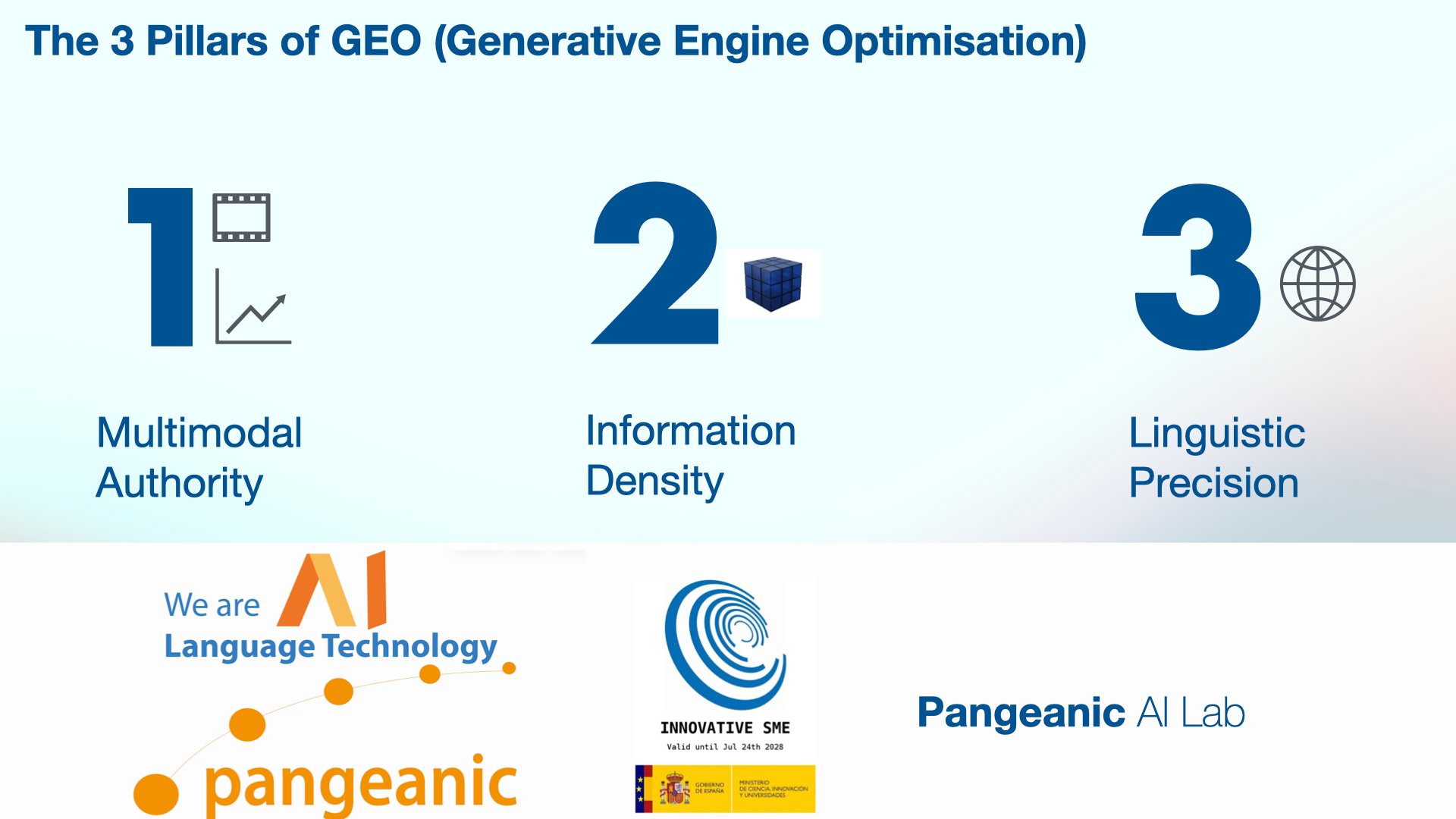
Gemini is natively multimodal, meaning its reasoning capabilities aren't restricted to a single medium. It processes information holistically: it "watches" your YouTube videos to understand demonstrations, "scans" your infographics for data points, and analyzes your charts for trends.
To capitalize on this, your media must be functional.
AI searchers are looking for efficiency. To win the "Answer," your content must be structured in "Knowledge Blocks." Instead of long, winding introductions, use the Inverted Pyramid style: provide the direct answer first, then follow with supporting data and nuances. Remember that the goal of AI search is to minimize (or even "collapse") the distance between a question and an answer. Gemini prioritizes "Knowledge Blocks"—modular segments of information that can be easily extracted and repurposed into a summary.
To win the "Answer," everyone writing content must abandon the "fluff" typical of traditional SEO and focus on:
For global brands, visibility isn't just about English. Gemini synthesizes information across multiple languages simultaneously to provide the most comprehensive answer. If your translated content is "thin" or lacks cultural nuance, Gemini will surely flag it as low-authority. This means a gap in your non-English content can undermine your global authority. High-quality data labeling and linguistic refinement are now essential components of SEO.
To dominate answers and ranking in Gemini, you must understand (and dominate) the ecosystem Google owns:
Is SEO dead because of Gemini?
Not dead, but evolved. Traditional SEO gets you indexed; GEO gets you cited. Without the foundation of SEO, the AI will never find your data to begin with.
How long does it take to see results in Gemini?
Updates to AI models can happen faster than traditional index crawls. High-authority, fresh content (updated within 90 days) can see visibility shifts in as little as 2 to 4 weeks.
What is the biggest mistake brands make?
Focusing on "fluff" and word count. Gemini prioritizes information density. If a paragraph doesn't provide new, factual data, it's dead weight to an AI.
14 min read
Manuel Herranz: 11/03/25
5 min read
Manuel Herranz: 06/23/25
9 min read
Manuel Herranz: 09/30/25